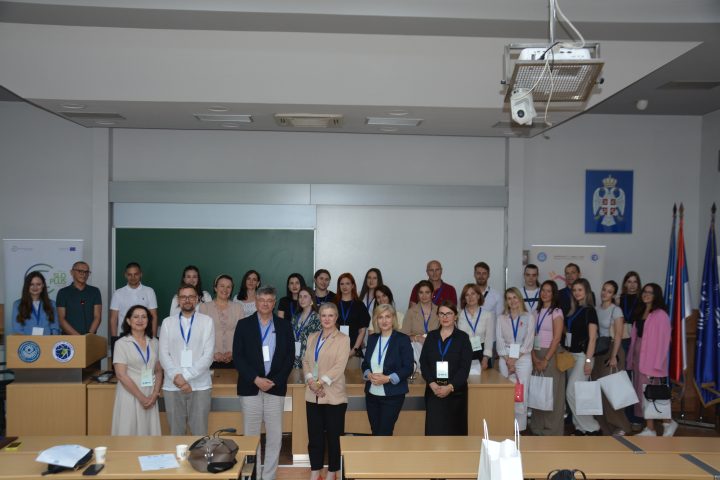
The Faculty of Natural Sciences and Mathematics at the University of Banja Luka hosted the NanoPol Conference on Nanomaterials and Polymers for the fifth consecutive year on 18 June 2026, organized by the Chemistry Department.
NanoPol has become a traditional scientific event that brings together researchers in the fields of nanomaterials, polymers, and related disciplines with representatives of industry, aiming to promote the exchange of the latest scientific achievements and strengthen collaboration between academia and the industrial sector. The participants were welcomed by Prof. Dr. Dino Hasanagić, Vice Dean of the Faculty of Natural Sciences and Mathematics, and Prof. Dr. Kristina Pantelić Babić, Vice Rector of the University of Banja Luka. The conference was officially opened by Branka Savić, Head of the Science Department at the Ministry of Scientific and Technological Development and Higher Education of the Republic of Srpska.
This year’s programme focused on domestic and European raw materials for the production of nanomaterials and polymers, with particular emphasis on current scientific challenges, industrial applications, and safety aspects of these materials. One of the highlights of the conference was a lecture presenting the first analysis of crude oil from the Tuzla Canton oil field. The analyses were performed at the Faculty of Chemistry, University of Belgrade, in collaboration with the Federal Institute of Geology, which was responsible for sampling, while the Chemistry Study Programme of the Faculty of Natural Sciences and Mathematics initiated the collaboration. The lecture was delivered by Prof. Dr. Branimir Jovančićević from the University of Belgrade.
The conference also featured Prof. Andrej Bieśikirski from Poland, a long-standing collaborator of the Chemistry Study Programme. This successful cooperation has resulted in four joint scientific publications, while a project proposal in the field of nanomaterials has recently been submitted under the Horizon Europe Pathfinder programme.
Special attention was devoted to the regulatory framework governing the safety of nanomaterials and polymers. Irena Medarević Milobratović, M.Pharm., Director of the Estonian company Inadea, presented the importance of aligning domestic products with the European regulatory framework. Her company provides international consulting services in regulatory affairs related to chemicals and advanced materials.
Assoc. Prof. Dr. Ema Obralić, Quality Director at Solana d.d., presented quality control standards in salt production while also discussing recent scientific findings on the presence of microplastics and nanoplastics in sea salt. This issue has gained increasing attention in scientific literature as a consequence of marine pollution caused by plastic waste.
The conference concluded with a presentation by Dragana Stević, Director of the BP Institute, who presented the results of research on a composite polymer–graphene oxide membrane developed for the removal of toxic metal ions from wastewater. The research was conducted in collaboration with the Faculty of Natural Sciences and Mathematics and was published earlier this year in an international scientific journal.
As part of the conference programme, eight Master’s students from the Faculty of Natural Sciences and Mathematics presented their research through a poster session dedicated to nanomaterials and polymers. The event concluded with a visit to Mikroelektronika, where participants learned about the company’s activities in establishing recycling systems for various types of polymers generated during the manufacturing process.
The conference was financially supported by the Ministry of Scientific and Technological Development and Higher Education of the Republic of Srpska.