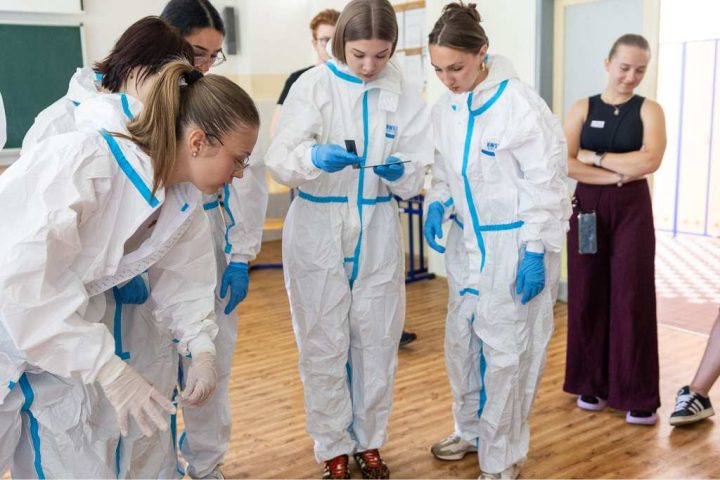
From 22 to 26 June 2026, the international summer school “Forensic Chemistry” was held in Pardubice, Czech Republic, as part of the Erasmus+ ChemTeach project. The project aims to improve the quality of chemistry teaching in vocational education through the development of modern teaching methods, practical laboratory work, and international cooperation.
The summer school brought together students and teachers from partner institutions in Bosnia and Herzegovina, Slovakia, and the Czech Republic, including the University of Banja Luka, the Slovak University of Technology in Bratislava (project coordinator), secondary chemical schools from Bratislava and Pardubice, as well as the Banja Luka Gymnasium, Banja Luka Medical School, and Banja Luka School of Technology.
Working in international teams throughout the five-day programme, participants solved a simulated forensic case using a variety of laboratory methods. Through crime scene evidence analysis, laboratory exercises, presentations, and a final mock court trial, they enhanced their knowledge of forensic chemistry while developing analytical thinking, teamwork, and communication skills. The programme also included a workshop on the application of virtual reality technologies in education, as well as a study visit to Prague.
The summer school was the third and final international summer school organised within the ChemTeach project, following similar activities held in Slovakia and Bosnia and Herzegovina. Its objective was to strengthen cooperation among partner institutions and enhance the competences of students and teachers in the field of chemistry.
In addition to the academic programme, participants had the opportunity to explore the cultural and historical landmarks of the Czech Republic through an organised tour of Pardubice and a study visit to Prague, including visits to the Police Museum and the Alchemy Museum.
The summer school enabled participants to acquire new knowledge in forensic chemistry, improve their laboratory and digital competences, develop critical thinking and teamwork skills, and further strengthen international cooperation through the exchange of experiences with peers from other countries.
Author: Dejana Savić, MA